We recently welcomed Olivia Bailey MP (Reading West and Mid Berkshire) to Bonfire Fireplaces & Stoves, our showroom in Silchester, Reading (RG7 2PQ), for a detailed, evidence-led discussion on wood burning, air quality, and the Environmental Improvement Plan 2025 (EIP25).
The visit followed direct correspondence with our Managing Director, Marc Barlow, including a formal parliamentary briefing outlining the real-world impact of domestic heating policy on emissions, cost of living, and energy security.
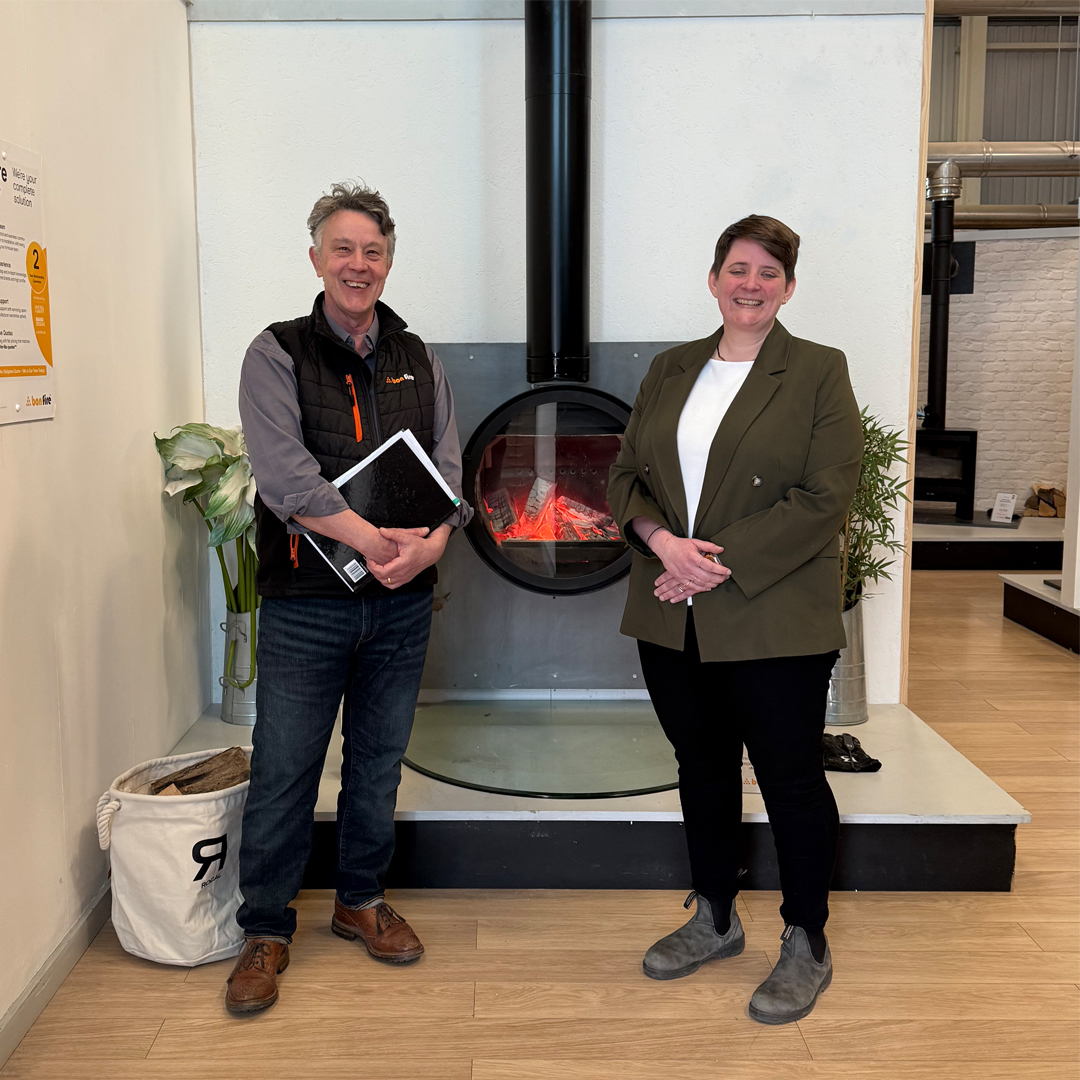
Olivia attended to review verified data, understand how modern Ecodesign wood burning stoves perform in practice, and engage directly with an established, independent specialist responsible for the design, supply and installation of fireplaces and stoves across Berkshire and the South of England.
Olivia Bailey MP also shared her visit publicly, highlighting the discussion around modern wood burning stove technology.
Estimated reading time: 9 minutes
Table of contents
- A Leading Fireplace & Stove Specialist in Reading, Berkshire
- Purpose of the Visit: EIP25, Air Quality & Policy Accuracy
- Emissions Data: Where the Problem Actually Sits
- PM2.5 Explained: What It Is and Why Modern Stoves Are Different
- The Performance Gap: Open Fire vs Ecodesign Stove
- Carbon and Energy: A Renewable Alternative
- Cost of Living and Energy Security
- Real World Limitations of Alternatives
- Fuel Quality and Installation Standards
- Local Economic Impact
- A Balanced Approach to Policy
- A Constructive Visit Focused on Evidence
- Visit Our Fireplace & Stove Showroom in Reading
- Final Statement
- FAQ
A Leading Fireplace & Stove Specialist in Reading, Berkshire
Bonfire Fireplaces & Stoves is a family run business established in 2003, with a dedicated showroom in Silchester, Reading.
We specialise in wood burning stoves, gas fires, electric fires, bioethanol fires, fireplaces, and full flue and chimney systems. Our service is fully in-house, covering design, supply, installation, and ongoing maintenance.
We provide a complete in-house service:
- Design
- Supply
- Installation
- Servicing and aftercare
Our team includes HETAS and Gas Safe qualified, experienced installers and surveyors, ensuring every project is completed safely, correctly, and to current UK standards.
This end-to-end expertise positions us as a trusted specialist for fireplaces and stoves in Reading, Berkshire and across the South of England.
Explore our core services:
Purpose of the Visit: EIP25, Air Quality & Policy Accuracy
The discussion centred on EIP25 and its relationship with the Clean Air Act, particularly around particulate emissions (PM2.5) and domestic heating.
A key concern raised in our briefing is reversion risk.
If homeowners are discouraged from upgrading to modern Ecodesign stoves, they are far more likely to continue using:
- Open fires
- Older, inefficient stoves
This creates the opposite effect of what policy intends.
Open fires can produce up to 10 times more particulate emissions than a modern Ecodesign stove. Slowing the transition to cleaner technology risks increasing overall PM2.5 levels rather than reducing them.
Emissions Data: Where the Problem Actually Sits
Using the latest data from Defra and the National Atmospheric Emissions Inventory (NAEI), we presented a clear breakdown of domestic wood related emissions.
The majority of emissions come from uncontrolled or outdated sources:
- Open fires: ~70% of domestic wood emissions
- Older stoves (pre-2022): ~22%
- Modern Ecodesign stoves: ~8% (minimal contribution)
In terms of total UK PM2.5 contribution:
- Open fires contribute the highest proportion
- Older stoves follow
- Modern Ecodesign stoves contribute a comparatively low and controlled share
This distinction is critical. Modern appliances are not the primary issue, uncontrolled burning is.
For homeowners looking to upgrade:
PM2.5 Explained: What It Is and Why Modern Stoves Are Different
PM2.5 refers to very fine particulate matter (tiny airborne particles) that can affect air quality and human health when present in high concentrations. It is a key focus of UK air quality policy, including EIP25.
There is often confusion around wood burning and PM2.5. The important distinction is that not all wood burning is the same.
Open fires produce the highest levels of particulate emissions. Older stoves (particularly those installed before 2022) also produce significantly higher emissions. In contrast, modern Ecodesign stoves are specifically engineered to reduce particulate output to a much lower, controlled level.
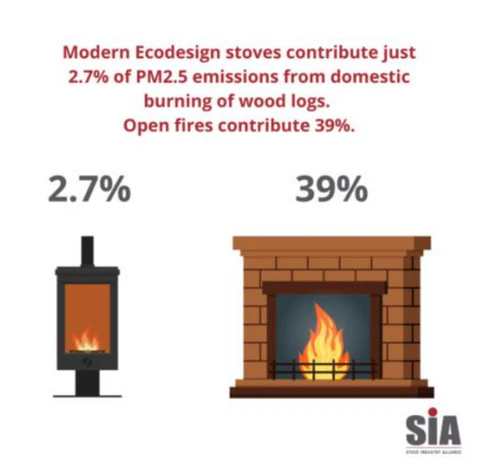
Data shows that modern Ecodesign stoves account for a relatively small proportion of total PM2.5 emissions, with the majority coming from uncontrolled sources such as open fires and outdated appliances.
In real terms, an open fire can produce around 10.0g/hr of PM2.5, whereas a modern Ecodesign stove typically produces around 0.1 to 0.7g/hr. Upgrading can reduce particulate emissions by up to 90%.
To put that into context, using an open fire for an evening can produce similar particulate levels to multiple days of controlled use from a modern Ecodesign stove.
It is also important to understand that emissions are heavily influenced by how the appliance is used. Burning dry, properly seasoned “Ready to Burn” wood (under 20% moisture) and ensuring correct installation both play a significant role in reducing emissions further.
The key point is this: PM2.5 concerns are valid, but modern, correctly installed Ecodesign stoves using the right fuel are not the primary issue. The real problem lies with open fires, poor fuel quality, and older, inefficient systems.
Learn more about Wood Burning Stoves and PM2.5
The Performance Gap: Open Fire vs Ecodesign Stove
Real world emissions data demonstrates a clear difference:
- Open fire: approximately 10.0g/hr PM2.5
- Ecodesign stove: approximately 0.1–0.7g/hr PM2.5
Upgrading from an open fire to a modern stove can reduce particulate emissions by up to 90%.
This is one of the most effective immediate improvements available within domestic heating.
Carbon and Energy: A Renewable Alternative
Wood is a renewable biomass and operates within a natural carbon cycle. Unlike fossil fuels, it does not introduce new carbon into the atmosphere.
Lifecycle carbon intensity:
- Wood (Ecodesign stove): ~19g CO2e/kWh
- UK electricity: ~126g CO2e/kWh
- Natural gas: ~210g CO2e/kWh
- Heating oil: ~298g CO2e/kWh
This positions modern wood burning as a low carbon and sustainable heating option when used correctly.
Cost of Living and Energy Security
The visit also addressed real household pressures, particularly rising energy costs.
For many homeowners:
- Wood costs approximately 9–10.5p per kWh
- Electricity can exceed 30p per kWh
- Zone heating reduces overall energy use
Key benefits:
- Up to 25% reduction in total heating costs through zone heating
- Independence from volatile energy markets
- No reliance on grid infrastructure
- Continued heating during power outages
This is particularly important for rural and off-grid homes, where alternatives can be limited.
To explore suitable systems:
Real World Limitations of Alternatives
While technologies such as heat pumps are important, they are not suitable for every property.
In older UK homes:
- Insulation may be insufficient
- Installation costs can be high
- Performance can vary
In these scenarios, modern wood burning stoves remain a practical, efficient solution
For tailored advice:
Fuel Quality and Installation Standards
Emissions are heavily influenced by usage and installation quality.
Best practice includes:
- Using “Ready to Burn” certified wood (<20% moisture)
- Correct appliance sizing and system design
- Professional installation and commissioning
At Bonfire Fireplaces & Stoves, we manage the full system:
- Appliance selection
- System design
- Installation
- Certification and aftercare
Learn more:
Local Economic Impact
Bonfire is a long established local employer, contributing to the regional economy:
We:
- Family run business serving Berkshire since 2003
- Employ 15 people locally
- Employing skilled local engineers and specialists
- Supporting responsible, compliant wood burning
- Serve customers across Berkshire and surrounding counties
- Provide expert guidance on responsible wood burning
The wider stove industry supports:
- Around 25,000 jobs across the UK
- Approximately £3.1 billion in annual economic activity
A Balanced Approach to Policy
We support the goals of improving air quality and reducing emissions.
However, the data clearly shows:
- The issue is primarily uncontrolled burning
- Modern Ecodesign stoves are already a significantly improved solution
- Discouraging adoption risks increasing emissions
The most effective approach is:
- Encouraging upgrades to modern systems
- Promoting high quality fuel
- Ensuring correct installation
A Constructive Visit Focused on Evidence
Olivia Bailey’s visit focused on understanding real world evidence, including:
This included:
- Reviewing emissions data
- Understanding installation practices
- Discussing real world heating needs
- Assessing the impact of EIP25
This level of engagement ensures policy is informed by industry expertise and factual data, not assumptions.
Visit Our Fireplace & Stove Showroom in Reading
Bonfire Fireplaces & Stoves
Unit 49, Easter Park
Benyon Road
Silchester
Reading
Berkshire
RG7 2PQ
Explore our full range:
Final Statement
Modern Ecodesign wood burning stoves, when installed correctly and used with the right fuel, are:
- Up to 90% lower emission than open fires
- Cost effective and efficient
- Low carbon and renewable
- Suitable for a wide range of UK homes
Bonfire Fireplaces & Stoves continues to lead with expert advice, professional installation, and evidence based guidance.
Encouraging modern systems reduces emissions. Discouraging them risks increasing them.
FAQ
Frequently Asked Questions: Wood Burning, EIP25 & Ecodesign Stoves
Are wood burning stoves being banned in the UK?
No. Wood burning stoves are not being banned. Modern Ecodesign compliant stoves are permitted and encouraged as they produce significantly lower emissions than older appliances and open fires. The focus of regulation is on reducing pollution from outdated and inefficient sources, not banning modern systems.
What is EIP25 and how does it affect wood burning stoves?
The Environmental Improvement Plan 2025 (EIP25) is a UK government strategy focused on improving air quality and reducing emissions. It highlights particulate matter (PM2.5) as a key concern. The discussion around wood burning centres on ensuring cleaner technologies are used, rather than eliminating modern Ecodesign stoves.
Do wood burning stoves cause air pollution?
All combustion produces emissions, but the level varies significantly. Open fires and older stoves produce the highest levels of PM2.5, while modern Ecodesign stoves produce substantially lower emissions when installed and used correctly with dry fuel.
How much cleaner is an Ecodesign stove compared to an open fire?
Modern Ecodesign stoves can reduce particulate emissions by up to 90% compared to a traditional open fire. This makes upgrading one of the most effective ways to improve air quality in homes that currently use solid fuel heating.
Are wood burning stoves environmentally friendly?
When used correctly, wood burning can be a low carbon heating option. Wood is a renewable biomass fuel that operates within a natural carbon cycle. Modern high efficiency stoves using properly seasoned wood minimise both emissions and environmental impact.
Is wood burning cheaper than gas or electricity?
In many cases, yes. Wood can be a cost effective heating option, particularly when used for zone heating (heating the main living area). It can also provide protection against rising energy costs and grid dependency.
Can I install a wood burning stove in a new build or modern home?
Yes, provided it complies with current regulations. Many modern homes can accommodate a stove, but it depends on factors such as ventilation, flue design and property layout. A professional survey is recommended to determine suitability.
Do I need a HETAS registered installer?
Yes. Using a HETAS registered installer ensures your stove is installed safely, complies with Building Regulations, and operates efficiently. It also provides certification required for insurance and property records.
What fuel should I use in a wood burning stove?
You should always use dry, seasoned wood with a moisture content below 20%, ideally certified as “Ready to Burn”. Wet or poor quality fuel increases emissions, reduces efficiency, and can damage your appliance and flue.
Are heat pumps better than wood burning stoves?
Heat pumps are an important low carbon technology, but they are not suitable for every property. In many older UK homes, installation cost, insulation levels and performance limitations mean that wood burning stoves remain a practical and reliable alternative.
Where can I get expert advice on wood burning stoves?
You can visit our showroom in Reading or book a home survey with Bonfire Fireplaces & Stoves. We provide expert guidance on stove selection, installation, and ongoing maintenance across Berkshire and the surrounding areas.