Few elements in a home evoke the same warmth, both literal and emotional, as a fireplace.
For centuries, fireplaces have been at the heart of the household – once essential for survival, now often cherished for comfort, design, and nostalgia.
But how did the humble fireplace evolve? Why was it so important, and what does its future look like?
This blog post explores the rich and fascinating history of the fireplace, from prehistoric fire pits to today’s sleek, wall-mounted electric units.
Estimated reading time: 7 minutes
Table of contents
- The Prehistoric Hearth: Fire’s First Home
- The First Indoor Fireplaces: Ancient Civilisations
- The Medieval Hearth and Hall House
- The Renaissance and the Birth of Fireplace Design
- Industrial Revolution: Mass Production and Cast Iron Stoves
- The 20th Century: Decline and Reinvention
- The Modern Fireplace: Technology Meets Aesthetics
- Cultural Significance and Symbolism
- Environmental Impact and the Future
- Conclusion: The Enduring Appeal of the Fireplace
The Prehistoric Hearth: Fire’s First Home
Long before bricks, chimneys or mantels, early humans gathered around simple fire pits.
Archaeological evidence from as far back as 400,000 years ago shows that early hominids used contained fire in caves and open dwellings.
These early hearths which were usually a shallow pit or stone circle offered warmth, cooked food, and kept predators away.

Source: ResearchGate
Interestingly, these primitive hearths were also social and cultural hubs. Firelight extended the day, allowing time for storytelling and community bonding.
It’s no exaggeration to say the hearth helped shape early civilisation.
The First Indoor Fireplaces: Ancient Civilisations
As humans moved from nomadic life to permanent settlements, fire came indoors. The ancient Romans were especially advanced in using fire to heat buildings.
In grand villas, they developed the hypocaust system, a kind of underfloor heating that used a raised floor and flues in the walls to circulate warm air.

Though not a fireplace in the modern sense, it shows how fire was integrated into home life for both function and luxury.
In northern Europe, early homes had central hearths with smoke venting through thatched roofs, often with no chimney at all. The entire room would be filled with smoke, leading to the phrase “smoke-filled room,” still used metaphorically today.
The Medieval Hearth and Hall House
By the Middle Ages, the fireplace as we’d recognise it began to take shape.
Around the 11th century, stone built houses with dedicated fireplaces and chimneys became more common, especially in manor houses and castles.
The chimney was a major innovation: it directed smoke out through the roof, improving indoor air quality dramatically.

In a typical hall house, the fire was still central to the room. It provided heat for the household, but also symbolised the social centre. People sat, worked, ate and slept around it.
These fires were large and open, sometimes raised on a stone hearth, and often used enormous logs, hence the term “Yule log.”
The Renaissance and the Birth of Fireplace Design
During the Renaissance period (15th–17th century), fireplaces evolved from purely functional structures to artistic and architectural features.
In Italy and France, grand stone or marble fireplaces with intricate carvings became focal points of rooms.

This era also saw the rise of mantelpieces, decorative frameworks that framed the fireplace and allowed room for artwork or family crests. Fireplaces were no longer just for warmth – they were for showing wealth, taste, and status.
Simultaneously, practical improvements were made. In England, Sir Benjamin Thompson (a.k.a. Count Rumford) revolutionised fireplace design in the late 18th century.
He developed a taller, narrower firebox and a streamlined chimney that improved airflow and reduced smoke. The Rumford fireplace became the standard for efficient heating in many homes.
Industrial Revolution: Mass Production and Cast Iron Stoves
The 18th and 19th centuries brought massive changes to heating technology. With the rise of the Industrial Revolution came the ability to mass-produce fireplace components.
Cast iron inserts, fire grates, and coal burning stoves became common in Victorian homes. These were often smaller and more efficient than open fireplaces.

Source: Victorian Emporium
Coal overtook wood as the primary fuel, especially in urban areas. Victorian fireplaces were typically ornate, with decorative tiles and cast iron detailing, reflecting the era’s love for ornamentation and craftsmanship.
Chimneys also became widespread in working-class homes, often shared among several fireplaces through a flue system – a marvel of domestic engineering for its time.
The 20th Century: Decline and Reinvention
In the early 20th century, fireplaces were still central to home life. But their dominance began to wane with the advent of central heating. Radiators, gas heaters and electric heating offered clean, convenient warmth in every room.
However, rather than disappearing, the fireplace adapted. In the post-war period, especially in suburban homes of the 1950s and ’60s, fireplaces were more about style and ambience. Brick built fireplaces with simple mantels became popular in mid-century modern design.
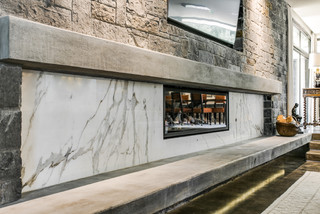
Photo by Aria Stone Gallery – Search living room design ideas
In the 1970s, the energy crisis prompted a return to wood burning stoves, which were more efficient than open fires. These stoves often had sealed doors and could radiate heat for hours.
The Modern Fireplace: Technology Meets Aesthetics
Today, the fireplace continues to evolve. While not always necessary for heating, it remains a desirable feature for atmosphere and style.
Modern options include:
- Gas fireplaces – easy to use, with remote controls and ventless designs.
- Electric fireplaces – efficient, clean, and often used for decorative purposes.
- Ethanol burners – eco-friendly and smoke-free, popular in minimalist interiors.
- Smart fireplaces – integrated with home automation systems for convenience and control.
Design trends now range from rustic wood burning stoves in country cottages to sleek, wall mounted units in high-end flats. The fireplace has become a canvas for interior designers, blending function and form in ever more creative ways.
Cultural Significance and Symbolism
Throughout history, the fireplace has symbolised more than just heat. In literature, it’s often the seat of memory, comfort, and home. Phrases like “hearth and home” or “gathered around the fire” evoke deep emotional ties.
In some cultures, the hearth was sacred. In ancient Rome, for example, Vesta was the goddess of the hearth, and her flame was never allowed to go out.

In Ireland, the hearth was traditionally the heart of the house, used for both cooking and storytelling.
Even today, during festive seasons like Christmas, fireplaces are associated with family, warmth, and tradition – think of Santa coming down the chimney!
Environmental Impact and the Future
While romantic and cosy, fireplaces have come under scrutiny for their environmental impact. Burning wood or coal releases carbon and particulates into the air. In response, many countries now regulate the types of stoves and fuels allowed.

Fortunately, innovation continues. Eco friendly inserts, clean burn technology, and bioethanol fireplaces are making the hearth greener than ever. Smart thermostats and renewable fuels are likely to shape the fireplaces of tomorrow.
Conclusion: The Enduring Appeal of the Fireplace
From ancient fire pits to high-tech heat sources, the fireplace has evolved dramatically over the centuries. It has warmed bodies and hearts, stood at the centre of family life, and adapted to changing technologies and tastes.
Whether made of stone, brick, steel or glass, the fireplace remains a timeless symbol of comfort, tradition, and home.
So next time you sit by a fire, real or artificial, you’re not just warming up. You’re connecting with a history that stretches back to the dawn of humanity.