Fireplace beams, often called mantels, are both functional and decorative. Getting their height right ensures safety, compliance, and aesthetic appeal.
There is no universal answer to the correct height for a fireplace beam above a wood burning stove or gas fire, as it depends on the specifics of your installation and the manufacturer’s guidelines.
Keep reading and we’ll show you how to work this out based on your situation.
Estimated reading time: 12 minutes
Table of contents
- Why Fireplace Beam Height Is Important for Safety, Heat & Compliance
- What Is the Recommended Fireplace Beam Height in the UK? (With Measurements)
- Fireplace Beam Clearance Regulations (UK)
- Non Combustible vs Combustible Fireplace Beams: Key Differences & Safety
- How Far Should a Fireplace Beam Be from the Flue Pipe?
- How to Reduce Fireplace Beam Clearance Distances Safely
- Best Materials for Fireplace Beams (Safe & Heat Resistant Options)
- Fireplace Beam Design Tips: Height, Proportion & Styling
- Why Professional Fireplace Beam Installation Is Important
- How to Maintain and Protect Your Fireplace Beam
- Fireplace Beam Height & Clearance Summary (Key Takeaways)
- Fireplace Beam FAQs (Clearances, Safety & Installation)
It is important to note that this information is not located in Document J of the UK Building Regulations.
Instead, it’s determined by the following factors:
- Stove heat output
- The manufacturer
- Type of flue used (single skin/ twin wall)
- Material of the beam
To ensure the correct and safe installation of your fireplace beam, you should always consult a HETAS registered engineer, who can clarify the application for your specific setup, as every installation is different.
Find your local HETAS engineer here
Why Fireplace Beam Height Is Important for Safety, Heat & Compliance
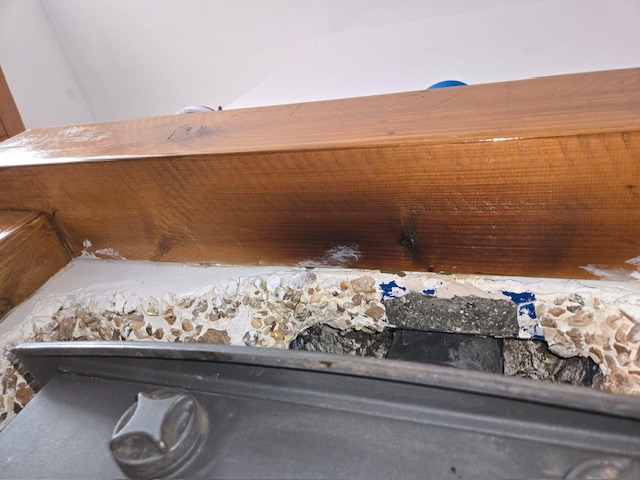
The height of a fireplace beam is essential for safety and comfort. If placed too low, the heat from the fireplace can damage the beam or create a fire hazard.

Furthermore, a poorly positioned beam can not only disrupt the aesthetic of your room’s design but also pose a serious safety risk if improperly installed, potentially becoming unstable and detaching from the wall.
What Is the Recommended Fireplace Beam Height in the UK? (With Measurements)
In the UK, the typical height for a fireplace beam is between 1,200mm and 1,350mm (120cm to 135cm) from the floor. This range is suitable for most standard fireplaces.
However, always consider the size of your fireplace and the proportions of the room. It is also essential that it is installed safely and in accordance with manufacturers guidelines.
Fireplace Beam Clearance Regulations (UK)
There is no single fixed distance set in UK law for fireplace beam clearances.
Instead, safe distances are determined by a combination of:
- Stove manufacturer’s instructions (primary requirement)
- UK Building Regulations – Approved Document J
- The type of beam (combustible or non combustible)
- Stove heat output (kW)
- Flue type and position (single wall or twin wall)
Non Combustible vs Combustible Fireplace Beams: Key Differences & Safety
Fireplace beams are available in both combustible and non combustible materials. Choosing the right one depends on your fireplace setup and clearance requirements.
Minimum Distance Between a Stove and a Non Combustible Beam or Surround
Non combustible beams are designed for use where clearances from a stove do not allow timber beams. These beams are typically made from materials like plaster or stone, ensuring safety when placed close to the stove.
Suggested minimum clearances for non combustible beams and surrounds above a stove or flue (UK):
- 5kW stove: at least 250mm above the stove or flue outlet
- 7kW stove: at least 350mm above the stove or flue outlet
Are Fireplace Beam Clearance Distances a Legal Requirement?
No, these are general guidance clearances.
You must always follow:
- The stove manufacturer’s installation instructions (these take priority)
- UK Building Regulations – Approved Document J
Why Non Combustible Beams Still Require Clearance from a Stove
Even non combustible materials (such as stone, concrete, or steel):
- Can absorb heat
- Can transfer heat to nearby materials
- May become unsafe if positioned too close
When Do Fireplace Beam Clearance Distances Change?
Clearances may vary depending on:
- Stove design and output
- Flue position and configuration
- Installation type (e.g. inside a chamber or freestanding)

These distances are based on manufacturers’ guidelines. If placed closer than recommended, the material may crack due to excessive heat. Non combustible beams are suitable for gas and solid fuel (wood or multi fuel) fires.
If clearance is limited, view our non-combustible fireplace beams → designed for installations where timber isn’t suitable.
Clearances for Combustible Fireplace Beams (Wood, Oak & Timber)
When using combustible beams, such as oak, careful positioning is crucial to prevent fire hazards. A HETAS registered installer should handle the installation, ensuring compliance with safety standards.

The stove’s manual will specify how close the beam can be positioned in relation to the stove. If the manual is unavailable, search online using your stove’s make and model.
For wood burning stoves, the average distance from the top of the stove to a combustible beam is 450mm (18″) as a minimum.
However, since 2024 the regulations have changed to 750mm (29.5″) from the top of the appliance if a manufacturer doesn’t state the distances.
This distance can vary based on the stove’s heat output and positioning (forwards/ backwards).
Gas fires also include clearance information in their manuals. Always follow these guidelines for safe installation.
Please also bare in mind the flue which also gets very hot! (Please see below).
If you’re choosing a beam, it’s important to match the material to your installation.
For a traditional look, you can browse our range of oak fireplace beams →
How Far Should a Fireplace Beam Be from the Flue Pipe?
As a general rule, combustible materials should be placed at least three times the diameter of the flue pipe away from the flue. For example:
- If the flue pipe is 5” in diameter, the beam should be at least 15” away from the flue.

This rule applies in any direction, whether upwards or diagonally as shown with A and B in the diagram above.
Twin Wall Flue Clearance Distances Explained
You can opt for Twin Wall Flue, which are insulated to reduce the required clearance distance.
Unlike single wall flues, which must be kept at least three times their diameter away from combustible materials, most twin wall flues have a much lower clearance requirement, typically 50mm, 60mm, or 70mm.
How to Reduce Fireplace Beam Clearance Distances Safely
If clearance distances cannot be met, consider these solutions:

- Heat Shields: Install a heat shield to protect the beam from excessive heat. These should have an air gap and conform to safety standards.
- Non Combustible Beams: Replace the wooden beam with a non combustible alternative.
Using Heat Shields for Fireplace Beams to Reduce Clearances
If you cannot meet the required clearances, a heat shield for a fireplace beam can be used to reduce the distance safely.
Heat shields work by deflecting and dissipating heat away from the beam, lowering the temperature exposure.
- Allows reduced clearances in tight installations
- Suitable for timber (combustible) beams
- Commonly used where beam height is fixed
For correct performance, heat shields should:
- Be installed with an air gap behind
- Cover the full width of the beam area above the stove
- Be made from heat resistant materials
Clearance reductions depend on the setup and must follow:
Approved Document J
Stove manufacturer guidelines
View our heat shields for fireplace beams →
Using Non Combustible Beams to Solve Clearance Issues
If you cannot achieve the required clearances with a timber beam, switching to a non combustible fireplace beam is one of the most effective solutions.
Non combustible beams are made from materials such as plaster, stone, or concrete, allowing them to be positioned closer to a stove or fire without the same fire risk as wood. This makes them ideal for installations where space is limited or where the desired beam height would otherwise breach clearance requirements.
In many cases, using a non combustible beam can:
- Allow installation at a lower height than a timber beam
- Maintain the visual look of a traditional fireplace
- Help achieve compliance where combustible materials cannot
However, it is important to note that non combustible does not mean heatproof. These materials can still absorb and transfer heat, and in some cases may crack if installed too close to a heat source.
For this reason:
- Always follow the stove manufacturer’s clearance guidelines
- Ensure the installation complies with Approved Document J
- Consider additional protection (such as a heat shield) if space is particularly tight
Non combustible beams are commonly used with both wood burning stoves and gas fires, particularly in chimney chambers or media wall style installations where distances are restricted.
They offer a practical balance between safety, compliance, and design, making them a popular choice in modern fireplace installations.
Best Materials for Fireplace Beams (Safe & Heat Resistant Options)
Choosing the right material depends on clearance distances, heat exposure, and the overall fireplace design.
Solid Oak Beams
Solid oak beams offer a traditional, high end look.
- Fully combustible
- Require larger clearances from the stove
- Strong and durable
- Best suited where space allows safe distances
Hollow Oak Beams
Hollow oak beams provide the same appearance as solid timber with reduced weight.
- Combustible (same clearance rules as solid wood)
- Easier to install
- Lower cost than solid oak
- Common choice for decorative installations
Oak Veneer Beams
Veneer beams use a timber finish over a lightweight core.
- Combustible outer layer
- Lightweight and cost effective
- Ideal for aesthetic use where minimal load is required
- Must still follow timber clearance rules
Non Combustible Beams (Plaster & Cement Based)
Non combustible beams are made from heat resistant materials such as plaster and cement.
- Non combustible construction
- Can be installed closer to stoves than timber
- Suitable for tighter installations
- Designed to replicate timber or stone finishes
Solid Concrete Beams (Bespoke)
Bespoke beams may be made from solid concrete.
- Heavy – requires proper structural support
- Fully non combustible
- Extremely durable and heat resistant
- Suitable for custom or modern designs
Fireplace Beam Design Tips: Height, Proportion & Styling
- Match the room’s style: Choose a beam material and height that complements your room’s design.
- Keep proportions in mind: Ensure the beam doesn’t overwhelm the fireplace or appear too small.
- Use decorative elements: Add corbels or brackets for a traditional look, or keep it sleek for modern designs.
- Leave space for decor: If you plan to display items on the beam, allow enough clearance to avoid heat damage.
Why Professional Fireplace Beam Installation Is Important
Installing a fireplace beam requires precision and compliance with safety standards.
Hiring a professional ensures the beam is securely fixed and meets all regulations.
A HETAS registered engineer can also advise on the best materials and placement for your setup.
You can find your local hetas installer here
How to Maintain and Protect Your Fireplace Beam
- Regularly inspect wooden beams for cracks, warping, or heat damage.
- Clean the beam with appropriate products based on its material.
- Refinish wooden beams periodically to protect them from wear and tear.
Fireplace Beam Height & Clearance Summary (Key Takeaways)
When installing a fireplace beam, safety should always be your top priority. There is no one-size-fits-all rule, as clearances depend on your specific stove, flue setup, and the beam material.
Minimum non combustible beam clearances:
- 250mm above a 5kW stove/ flue
- 350mm above a 7kW stove/ flue
Minimum combustible beam clearances:
It was a known fact that 450mm (18″) as a minimum from the top of the stove/ flue is acceptable. However, since 2024 the regulations have changed to 750mm (29.5″) from the top of the appliance if a manufacturer doesn’t state the distances.
Always consult the manufacturer’s guidelines, follow building regulations, and work with a HETAS registered engineer to ensure a safe and compliant installation.
Fireplace Beam FAQs (Clearances, Safety & Installation)
Yes, you can paint a wooden beam using heat resistant paint. Ensure the paint can withstand temperatures near the fireplace. This does not then make the combustible wood non combustible.
Non combustible materials like metal or stone are ideal for modern designs due to their sleek and minimalistic appearance.
Consult a HETAS-registered installer for confirmation for the correct distance based on your installation.
Yes, you can install a fireplace beam yoursled but It is strongly recommended to hire a professional for safe and compliant installation, especially when working with combustible materials.
Ensure the beam is installed at the correct clearance and consider applying a heat resistant plate underneath with an air gap to create a barrier between the beam and the heat.
Non combustible beams can still crack if placed too close to a stove or fire. Follow manufacturer guidelines for proper clearances.
Yes, but ensure the beam is securely fixed and does not obstruct the fireplace opening or create a fire hazard.
Yes, an electric fire can only produce up to 2kW of heat output. As long as the fan is not covered, it is completely fine.
Clearances for corner fireplaces are generally the same, but ensure the beam placement aligns with safety guidelines for the stove and flue.
Inspect your fireplace beam at least once a year, checking for cracks, heat damage, or signs of wear.
Disclaimer:
Bonfire cannot be held liable for any damage resulting from the use or installation of fireplace beams; always consult a HETAS-certified engineer to ensure your installation is compliant and safely signed off.